Multimodal Pain Classification (m-PainAttnNet)

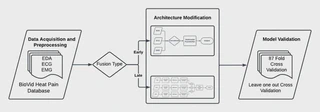 m-PainAttnNet Architecture
Automated pain assessment using physiological signals offers an objective alternative to self-reporting. m-PainAttnNet extends PainAttnNet to a multimodal setting, fusing ECG, EMG, and EDA signals through attention mechanisms to classify pain into 5 intensity levels. Evaluated on the BioVid Heat Pain Database (87 participants).
Key result: 98.8% accuracy on 5-class pain intensity classification, with cross-session robustness >75%.
Architecture
The model stacks three learned components:
- Multi-Scale CNN (MSCN) — extracts temporal features at short, medium, and long scales from 1D physiological signals; dropout 0.4–0.5 for regularisation.
- Squeeze-and-Excitation ResNet (SEResNet) — channel-wise attention recalibrates feature importance; residual connections maintain gradient flow; output dimensionality reduced to 30 channels.
- Transformer Encoder — 2-layer encoder, 6 attention heads; captures long-range temporal dependencies with layer normalisation and feed-forward networks.
Multimodal Fusion Strategies
Three fusion points were evaluated:
- Early fusion: concatenate modalities before MSCN
- Late fusion: process each modality independently, combine at the final layer
- Attention fusion: learn weighted modality combinations (best results)
Results
Ablation over architecture components
| Architecture | Accuracy | F1-Score |
|---|---|---|
| MSCN only | 70.2% | 70.7% |
| MSCN + SEResNet | 98.8% | 98.8% |
| MSCN + Transformer | ~93% | ~93% |
| Full m-PainAttnNet | 97.1% | 97.1% |
SEResNet’s channel attention provided the single largest accuracy jump (~28 pp). The full model trades a marginal accuracy drop for better generalisation.
Modality ablation (full model)
| Modalities | Accuracy |
|---|---|
| ECG only | 96.8% |
| ECG + EMG | 97.2% |
| ECG + EMG + EDA | 98.8% |
Dataset
BioVid Heat Pain Database — 87 participants, 5 pain levels (0–4: none to very high), synchronised ECG, EMG (trapezius, corrugator, zygomaticus), and EDA recordings across multiple sessions.
Technical Stack
PyTorch · NumPy · SciPy · Scikit-learn · K-fold cross-validation · Google Colab (GPU)
Project Report
Download PDF · Presentation slides
Course: CS6530 — Advanced Topics in AI, IIT Hyderabad (Jan–Apr 2024) · Supervised by Prof. Nagarajan Ganapati
